
What People Eat in Mount Albert – and What They Come Back For
Mount Albert is not a food destination. But something keeps people reordering, and the dishes that come up by name in those ratings say more about local food preferences than any menu does.
This is about what people here actually eat. Not where, what. East Gwillimbury turns out to have more restaurants with a twist on local food than the highway signs suggest.
01 The Brioche Burger
Ontario pub food, done differently
The standard Ontario pub burger arrives on a kaiser or a plain sesame bun. It does the job. Nobody talks about it after. A brioche bun changes the equation – softer, slightly sweet, toasts properly, holds together under a 7oz beef patty without collapsing. It also costs more, goes stale faster, and requires attention during prep. Most pub kitchens in small Ontario towns skip it. Independent kitchens that make this choice are signalling something about how they approach the rest of the menu. It’s a cost decision as much as a quality one, and when a kitchen absorbs that cost on a $14 burger, it shows up in the reviews.
The build-your-own format does the rest: cheddar with caramelized onions, or bacon with jalapeño, are the combinations that come up most. Simple choices on a bun that makes them matter. The build-your-own format does the rest: cheddar with caramelized onions, or bacon with jalapeño, are the combinations that come up most. The bun makes those choices matter in a way a kaiser roll doesn’t.
02 The Breakfast Sandwich
6am Ontario, no apologies
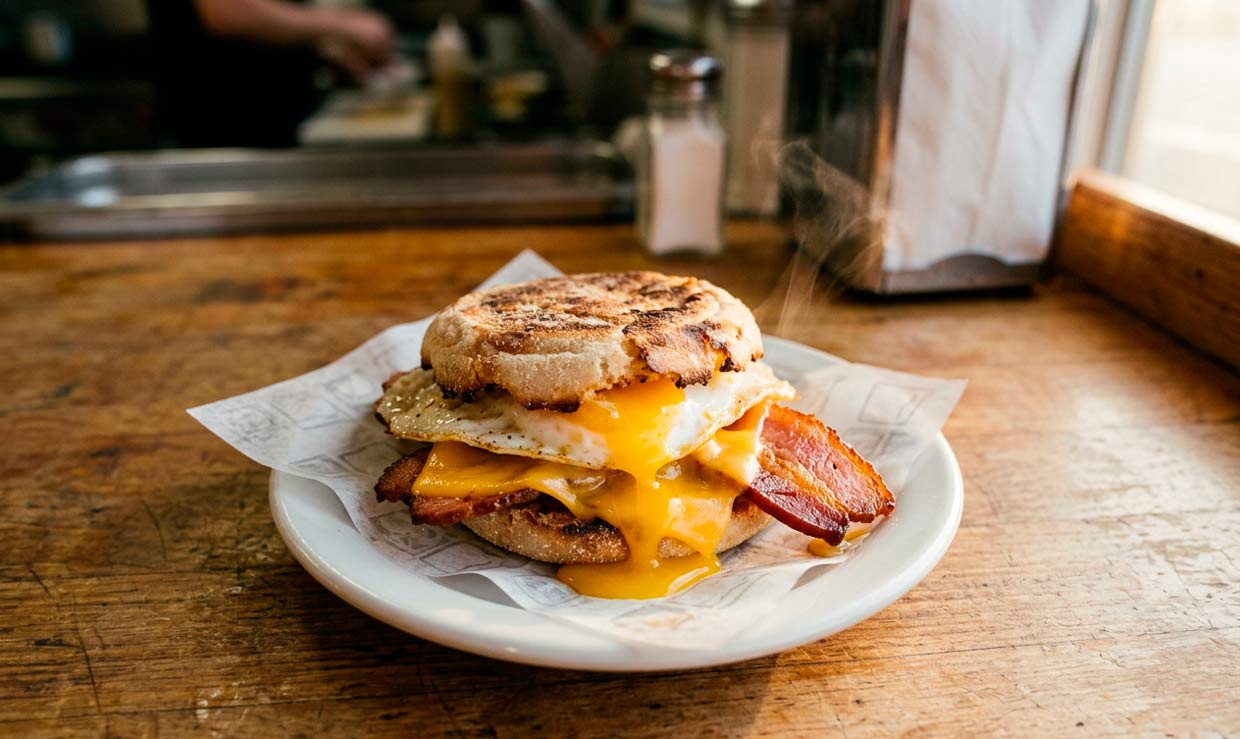
In Ontario, breakfast before 7am means Tim Hortons. That’s not a preference – it’s what’s open. The exception to that pattern, when it exists in a small Ontario town, is almost always a counter-service kitchen with a short menu and no interest in atmosphere. Open at 6:15am. No table service. No alcohol. The sandwich is the product. The menu is short. The breakfast sandwich has no name on it, listed generically, described generically, and yet it appears in consumer ratings more often than any named dish at any other spot in the area.
The benchmark one reviewer used: better than every Tim Hortons within 20km. In Ontario that’s a specific claim, not a compliment. 4.7 stars on 190 ratings. A high score on a small count means returning customers, not tourist traffic. People came back and rated it again. For fork brunch before 8am, this is the only option. The kitchen also sells soft serve from opening. At 6:15am on a Tuesday morning. Nobody has fully explained this. It is what it is.
03 Buttermilk Chicken
The dish that carries a kitchen
Properly brined, properly fried buttermilk chicken, the kind that stays moist under the crust and doesn’t need sauce, is less common in Ontario pub kitchens than it should be. When a version gets named unprompted in reviews, not “the chicken was good.” By description, specifically, cited as the reason for returning.
Alongside it: mashed potatoes described as the right call, not as a side but as part of the logic of the meal. A kitchen that does one thing consistently well across a menu that varies in quality is a specific kind of place. When regulars identify a dish without being asked, that’s not marketing. It’s the dish doing the work.
04 Smoked Meat & BBQ
What York Region was missing
BBQ as a serious food category has been absent from York Region for most of its recent dining history. Ribs at a chain pub, pulled pork on a sandwich – those exist. A kitchen built around a smoker, where brisket is the main event and burnt ends are a separate consideration, is newer. The standard is simple: brisket shouldn’t need sauce.
When a BBQ kitchen opens in a region that didn’t have one, the early reviews tend to reflect relief as much as judgement. Multiple reviewers in York Region used the same phrase without coordinating: the region needed this. Burnt ends and ribs are what come up specifically. The brisket holds the standard. One detail worth knowing: Friday evenings sell out early, whether that’s a demand signal or a supply planning issue is undocumented.
For group catering in the East Gwillimbury area, smoked meat is also the format that travels best. It holds during transport in a way that most restaurant food doesn’t.
05 The Chalk Menu
How local kitchens actually work
When a kitchen writes specials by hand on a board – rotating soups, weekly sandwich variations, seasonal additions – it means the menu is tied to what’s available, not to what was printed in bulk six months ago. Independent kitchens across York Region operate this way. Soups rotate. Sauces change weekly. Brunch items shift by season.
This is worth knowing before you drive out: what’s described online may not be what’s available on a given Saturday. The rotating format also produces the occasional dish that regulars mention for months – a weekly special that lands, a sauce combination that works, a soup that disappears and gets requested again. Fixed menus don’t do that. The chalk board is where local food preferences actually get recorded, one week at a time.
06 Vegetarian Food in a Pub Town
Present, but you have to ask
Mount Albert is a pub food town. That’s a description, not a complaint. And pub food in Ontario has not historically been a vegetarian category. The situation locally is better than the category average. A portobello mushroom burger built with broccoli, black beans and asiago cheese – pressed into a patty, served on brioche – is not a concession to vegetarians. That’s a dish with a specific construction. A grilled vegetable wrap with basil pesto mayo is the same signal: someone thought about it.
The gap is labelling. Most Mount Albert menus don’t mark vegetarian dishes as such. Knowing what’s plant-based requires asking. The stronger coverage for labelled vegetarian options is in the broader East Gwillimbury area, where at least one kitchen treats plant-based dishes as actual menu items rather than substitutions – marked, named, and described the same way meat dishes are.